Practice · 11 minute read
What happens when you hold a pose for a whole minute
Long holds are what people find hardest here, and the difficulty is not fitness. What each twenty seconds is like, why the mind gets loud at around forty, and the one rule that decides when to come out early.
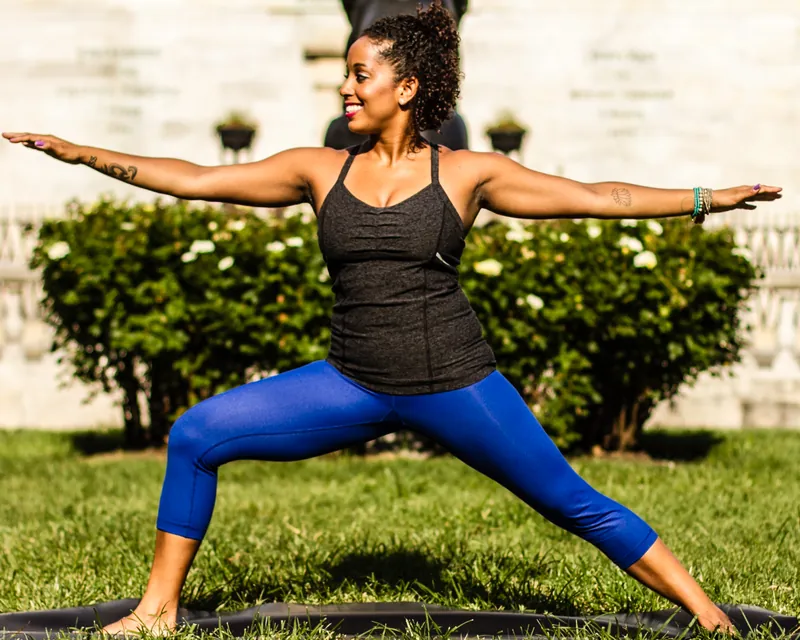
A sixty-minute class here gets through about twelve shapes. A class somewhere else might get through forty. The difference is entirely in how long each one is held, and it is the thing new people find hardest — far harder than any of the poses themselves.
It is worth explaining why we do it, because "slow is better" is not an argument, and because knowing what is supposed to happen during a long hold makes it considerably easier to stay in one.
The first twenty seconds: arranging
Nothing much is happening physically. You are still assembling the pose — finding the feet, working out whether the stance is wide enough, discovering that the front knee has already drifted. Most of the actual instruction in a class lands in this window, and in a fast class it is the only window, which is why a fast class can only ever tell you the shape.
Almost everybody is slightly wrong at this point and almost nobody can feel it yet. That is normal. The pose is not finished at twenty seconds; it has barely been started.
Twenty to forty: the pose starts reporting
This is where a long hold earns its keep. The shape has settled and the body begins sending back information that simply was not available before:
- Which muscles are actually working, as opposed to which ones you assumed were.
- Where the weight is in each foot — and how it is sliding, which you can only notice over time.
- Whether your breathing is still normal. It usually is not, and noticing that is most of the value.
- The difference between the two sides, which is invisible in a fast sequence and obvious in a slow one.
This is also the window in which corrections become useful. Telling somebody at five seconds that their shoulders are creeping up is wasted — they have not crept yet. At thirty seconds they have, the person can feel it, and the correction means something.
Forty to sixty: the mind gets loud
Here is the part nobody mentions in class descriptions. Somewhere around forty seconds, in a pose that is genuinely working, your attention starts looking for an exit. It offers you things: that this is long enough, that the teacher has lost track, that you could check how everyone else is doing, that you have remembered something urgent about Thursday.
This is reliable, it happens to experienced practitioners as much as to anybody, and it is not a character flaw. It is just what attention does when a task stops producing new information and starts producing sustained effort.
The useful move is not to push through it with gritted teeth. It is to give the attention something specific and small to do: count the breath, or find one more place in the foot, or notice the temperature of the air on your arms. The last twenty seconds get dramatically easier with a job to do, and that technique is most of what a long hold teaches that transfers anywhere else.
The rule that overrides everything
Level is fine. Growing means out, now.
A sensation that stays the same the whole way through a hold is fine — that is a muscle working, and it is supposed to be there.
A sensation that is bigger each time you notice it is the signal to come out immediately. Not at the end of the count, not when the teacher says so. Immediately.
And anything sharp, anything electrical, anything in a joint rather than in a muscle, and anything at all in your lower back means out at once, regardless of how long you have been there.
That rule is the single most important sentence on this site and it is why long holds need more care than fast sequences, not less. In a five-second pose nothing has time to accumulate. In a sixty-second pose it does, and the thing that accumulates is exactly the thing worth paying attention to.
The practical form of it, said out loud in every class: your breath is the test. If your breathing has gone short, shallow or stopped, the hold has gone past useful and you should come out whatever the count says. Nobody will notice and nobody would care if they did.
Coming out is part of the pose
The most undertaught moment in any class. People spend fifty seconds carefully holding a shape and then abandon it in half a second, which is when a knee gets twisted or someone gets light-headed standing up.
Three rules we use:
- Reverse the order you came in by. Arms down before the legs straighten, not the other way round.
- Take as long coming out as you took going in. If it took four seconds to arrange, take four seconds to leave.
- Stand still for a breath before the next thing. This is where you find out what the pose actually did, and it is the part most often skipped.
Coming up from any forward fold has its own rule on top of those: slowly, every time, with soft knees. That one is in all three fold guides.
How long is long enough
What we actually use, so you can match it at home:
- Standing Still — a full minute, at the start and the end.
- Warrior II, Reverse Warrior, Extended Side Angle — 30 to 45 seconds each side.
- Tree — 30 to 60 seconds each side, and a fingertip on the wall does not shorten it.
- Warrior III — 15 to 30 seconds. Shorter than the others on purpose; it asks a lot and there is nothing to be gained from grinding it out.
- Forward folds — 20 to 30 seconds, no longer.
None of those are targets and none of them are a standard. Twenty seconds of a pose you are actually in beats sixty seconds of a pose you left ten seconds ago and are now merely standing near.
What a long hold is not
Three misreadings worth heading off, because each one turns a useful practice into an unpleasant one.
It is not an endurance test. Nobody is measuring, there is no count to beat, and coming out at thirty seconds of a forty-five second hold has no consequence whatsoever. The teacher will not notice and would not mention it if she did. The number is a rough container for the experience, not a target.
It is not about stillness. You will shift, adjust, wobble and re-arrange the whole way through, and that is the pose working rather than the pose failing. A pose you are continuously adjusting is a pose you are continuously paying attention to.
It is not meditation. There is nothing you are supposed to be feeling or not feeling, no state to arrive at, and a mind full of Thursday is not a failure of anything. The only instruction about attention is a practical one: give it a small job and the last twenty seconds get easier.
Two long holds and what each one teaches
A concrete version of all of the above, using the two poses it shows up in most clearly.
Warrior II for forty-five seconds teaches you about the front knee. At ten seconds it is where you put it. At twenty-five it has drifted inward a little and you cannot feel it. At forty you can, because the thigh is working and the drift has changed what is working. That is a piece of information about your hips and your stance width that no amount of a five-second Warrior II will ever give you, and it is why this is the pose we hold longest.
Standing Still for a full minute teaches the opposite thing: that you are never still. In the first ten seconds it feels like nothing is happening. By thirty you can feel the sway — small continuous movement at the ankles, forward and back, side to side, constantly. By sixty most people can feel which direction they habitually drift in. That is the whole content of the pose, it is not available in under a minute, and it is the reason a class that looks like it starts with nothing actually starts with something.
Why not just do more poses instead
A fair question, and the honest answer is that both work and they teach different things.
A fast sequence teaches transitions, builds a bit of heat, and covers a lot of vocabulary. It is a genuinely good way to practise and there are excellent teachers doing it. If that is what you want, you should go and do that.
A slow practice teaches the inside of a shape — what it is like when it is well arranged, what drifts, what the second side tells you about the first. It is also much easier to do safely without a teacher in the room, because there is time to notice something going wrong before it has gone wrong.
We do the slow one. Not because it is better, but because it is the one where a cap of fourteen people and an hour of attention actually buys you something, and because standing work in particular rewards being examined.
Where to go next
The nine pose guides each carry a hold time and a care note in the same box. Practising at home deals with the practical side of doing any of this in a kitchen. The Tuesday Warriors class is the one built entirely around long holds.