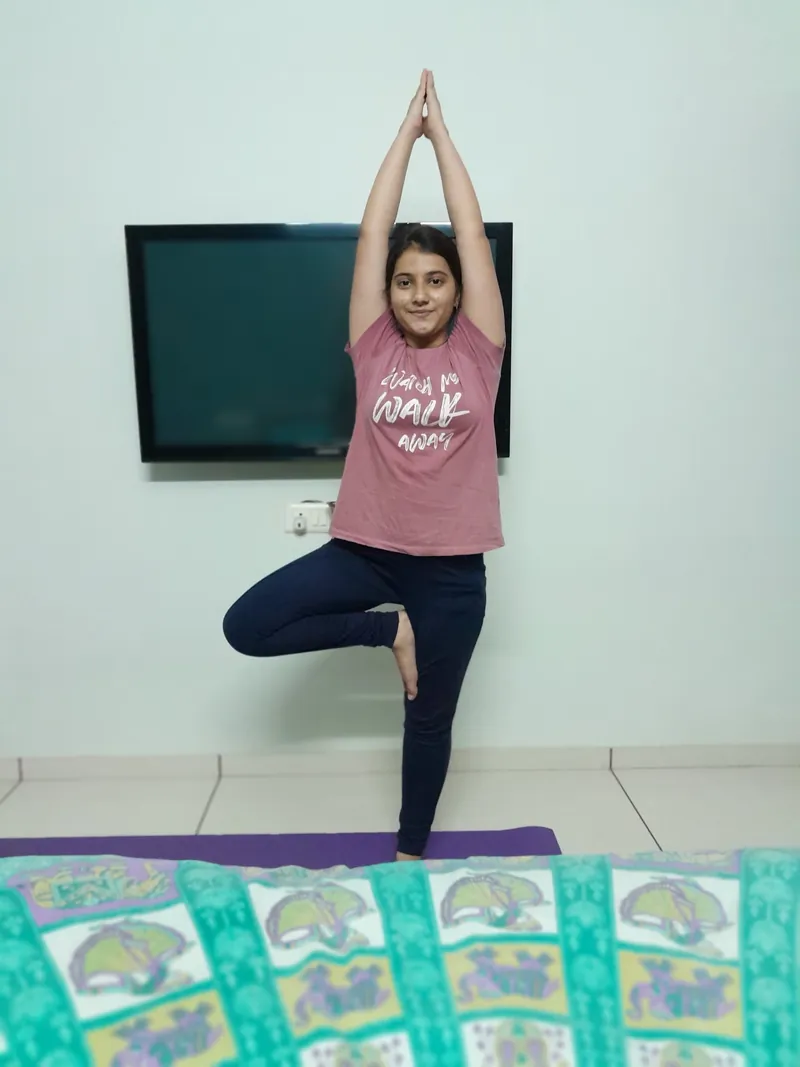
Tree
The balance everyone has heard of. Where the lifted foot goes matters far less than what the standing foot is doing.
Live classes from Burlington, Vermont
Cedar & Breath teaches standing practice and balance on a video call — nine classes a week, a published timetable, and never more than 14 people in the room so the teacher can actually see you.

Most of what we do happens on your feet. Warriors, the side angles, the standing folds, the balances. There is floor work in one class a week and none at all in the rest, which is a deliberate choice rather than a limitation: getting up and down off a floor is the part of a class that most often decides whether somebody comes back, and taking it out removes the question.
The pace is slow and the holds are long. A sixty-minute class here covers maybe twelve shapes, not forty. There is time to set your feet, time to find out what the pose is doing, and time to come out of it properly rather than falling out of it.
Everything is offered with a wall or a chair, every time, by name. Not as a modification announced once at the start for whoever needs it — as the version half the room is doing, including the teacher on the days her knee is complaining.
The first four of nine. The classes page has the whole week, what each class actually covers, and the dates we are closed.
| Day | Starts | Length | Class | Format |
|---|---|---|---|---|
| Monday | 45 min | Wake Up Standing | Standing | |
| Monday | 60 min | Balance Hour | Balance | |
| Tuesday | 60 min | Warriors | Standing | |
| Wednesday | 45 min | Wake Up Standing | Standing |
Free, with the chair version in the same box, because a chair version printed somewhere else is a chair version nobody uses.
The balance everyone has heard of. Where the lifted foot goes matters far less than what the standing foot is doing.
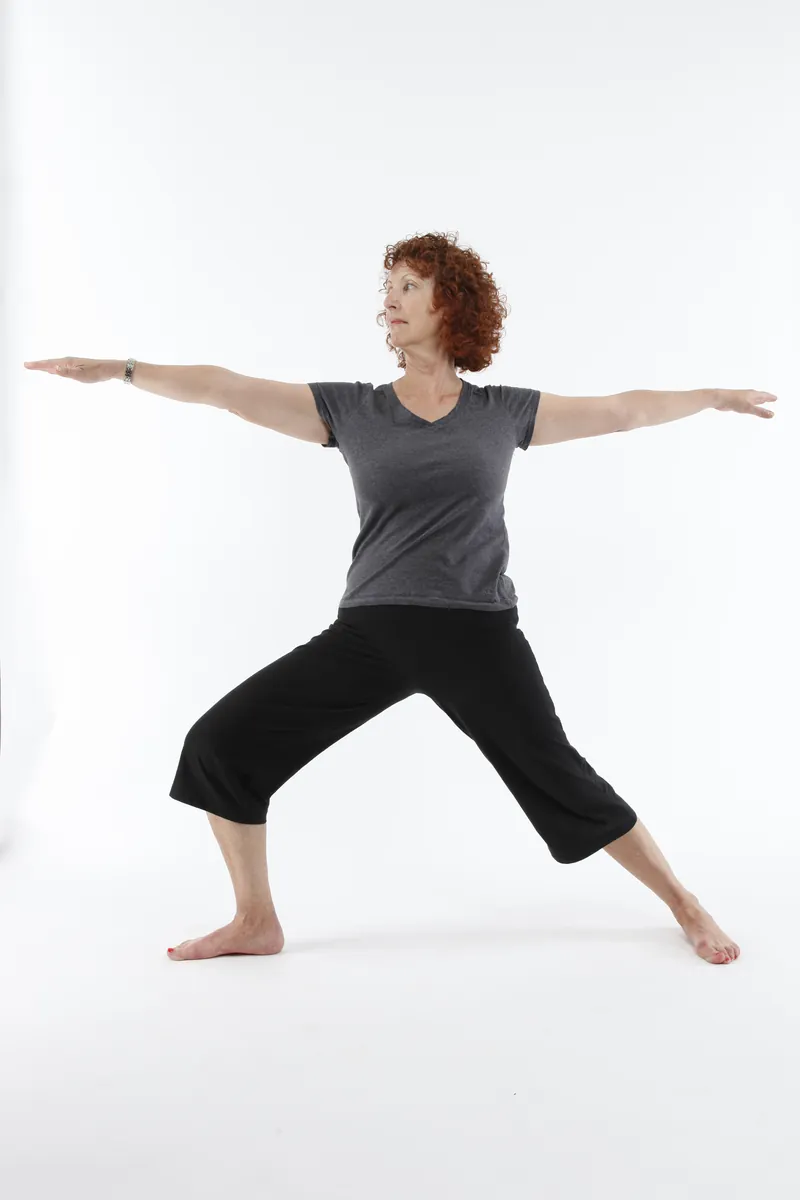
Wide stance, front knee bent, arms level. The pose that teaches you what your hips are actually able to do.
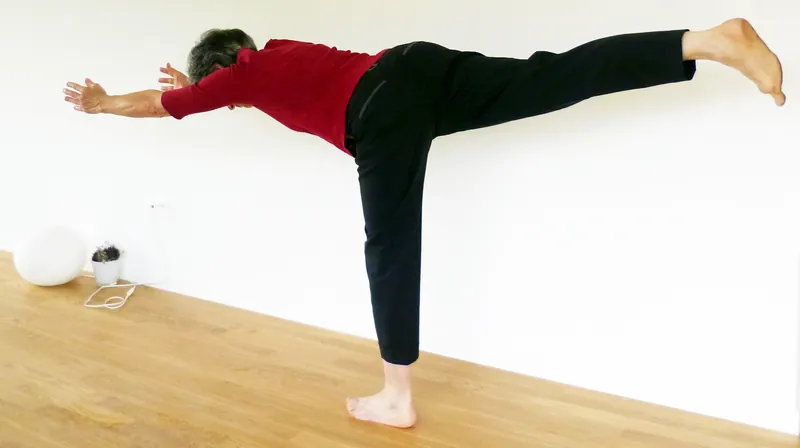
The hardest thing on the page, and the one most worth doing with your hands on a chair back for the first several months.
Classes are bought in packs. Nothing on this site renews, nothing is kept on file to charge you again, and there is no membership to cancel. A pack is a one-time payment and the credits sit in your name until you use them or until they expire.
$45.00$9.00 a class · expires 12 months from purchase
Enough to find out whether this suits you, across five weeks or five days — there is no rule about how fast you use them.
$80.00$8.00 a class · expires 12 months from purchase
Works out a dollar cheaper per class. Same expiry, same cancellation terms, same everything else.
People ask how many classes a week is the right number, and the honest answer is that it depends on what else is in your week — but here is what we actually see.
One a week is enough to keep the shapes familiar and is what most people settle on. A ten-class pack lasts about two and a half months at that rate, which is comfortably inside the expiry.
Two a week is where people start noticing things between classes — that they are standing differently waiting for a kettle, or that the second side of something has stopped being dramatically worse. A morning and an evening suits most schedules better than two of the same.
Three or more is plenty and is more than most people need. If you want to practise more often than that, the better use of the extra days is five or ten minutes on your own with one of the free pose guides, which costs nothing and does the thing that short frequent practice does well.
What does not work especially well is saving credits up and using four in a week. Standing practice rewards frequency over volume, and a fourth class in five days mostly produces tired legs.
Stated near the top rather than buried, because a class that is wrong for you wastes your money and our time.
It is not a workout. It is slow, it is not aerobic, and if that is what you are after you will be bored within twenty minutes. It is not a route to inversions, arm balances or a fast flow — we teach none of them. It is not on-demand: everything is live at a fixed time and nothing is ever recorded, so a missed class is a returned credit rather than something to catch up on. And it is not rehabilitation. If you are recovering from an injury or surgery and want a practice built around that, a physical therapist is the right person and a group class cannot do it.
We also make no health claims, about balance or anything else. The about page explains why at more length.
Three systems arguing about where you are in space, and what it means when they disagree. Why a wobble is information rather than a failure, and what practising a balance is practising.
Twenty-six bones doing the work, and the three points of contact that every standing pose on this site is built on. Plus why we take socks off.
Long holds are the thing people find hardest here. What the first, second and third twenty seconds are each like, and the one rule that decides when to come out early.
What you actually need, what you do not, where to put the laptop, and how to deal with a floor that slopes, a rug that slides and a cat who has opinions.
When the schedule changes, when a new pose guide goes up, and nothing else. Four or five emails a year. No sequence, no course, and the unsubscribe link works the first time.